MOMENTS BEFORE THE UNEXPECTED TURN: QUESTIONS SURROUND MARC ANTHONY AFTER AN EMOTIONAL SCENE SPARKS CONCERN AMONG FANS
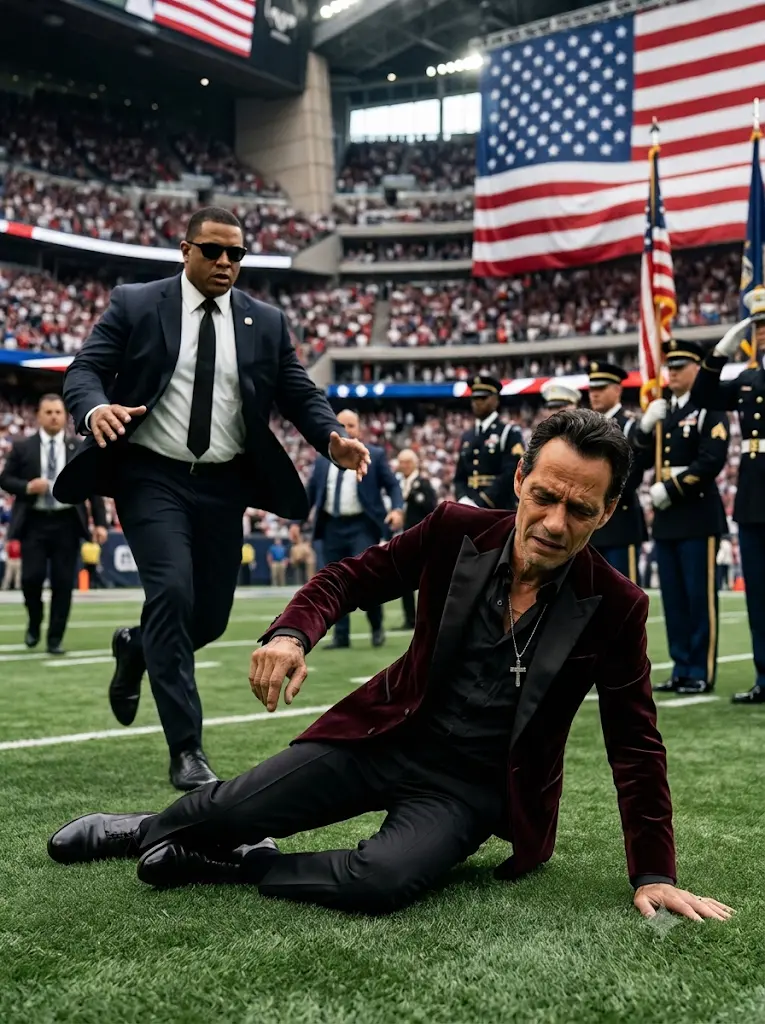
A brief but reportedly emotional moment involving international music superstar Marc Anthony has become the subject of a dramatic online narrative, prompting questions about what may have happened and whether the public has been given the full context. The description of an unexpected turn has raised concern among fans, but one important fact remains: no verified footage, eyewitness account, or official statement has been provided to establish the incident or confirm that the singer experienced a medical emergency.
For an artist whose voice has accompanied generations of listeners through celebrations, heartbreak, and deeply personal milestones, even the suggestion of an unsettling moment can generate a powerful emotional reaction.
Marc Anthony is not simply a successful recording artist. He is one of the most influential figures in contemporary Latin music, a performer whose career has crossed languages, musical genres, and international borders.
His distinctive voice, passionate performances, and extraordinary stage presence have helped him build a devoted audience around the world.
That connection explains why an ambiguous headline about his condition could immediately attract attention.
But concern and curiosity are not the same as confirmation.
As questions circulate, the distinction between what has been suggested and what can actually be established becomes especially important.
THE MOMENT THAT RAISED SO MANY QUESTIONS
The dramatic description begins with a suggestion that something unexpected happened shortly after an emotional moment involving Marc Anthony.
The wording creates an atmosphere of urgency.
It implies that observers witnessed something unusual.
It also suggests that the moment may have prompted questions about the singer's physical or emotional condition.
Yet the description does not identify where the incident supposedly occurred.
It does not provide a date.
It does not explain who witnessed the event.
And it does not include footage or a statement that would allow the circumstances to be verified.
Those missing details are significant.
A brief video clip, photograph, or eyewitness description can sometimes appear alarming when separated from its original context.
A performer may look exhausted after an intense concert.
An emotional expression may reflect the meaning of a song.
A sudden pause during a public appearance may have an ordinary explanation.
Without reliable evidence, it would be inappropriate to conclude that Marc Anthony experienced a health problem or another serious incident.
WHY FANS REACT SO STRONGLY TO NEWS ABOUT MARC ANTHONY
Marc Anthony has spent decades developing a uniquely personal connection with audiences.
His music frequently explores love, loss, devotion, resilience, and emotional transformation.
These themes have made his songs meaningful to listeners across different generations.
For some fans, his recordings are associated with weddings and family celebrations.
For others, they provide comfort during difficult personal experiences.
His performances are known for their intensity and emotional delivery.
That relationship between artist and audience can make even an uncertain report feel deeply personal.
When fans encounter an alarming description involving someone whose music has been part of their lives for years, their first reaction may be concern.
They want to know whether he is safe.
They want to understand what happened.
And they want reassurance that the story has not been exaggerated.
Those questions are understandable.
But answering them responsibly requires more than speculation.
FROM NEW YORK ROOTS TO INTERNATIONAL FAME
Marc Anthony was born Marco Antonio Muñiz on September 16, 1968, in New York City.
He grew up in a Puerto Rican family surrounded by musical influences.
His father, Felipe Muñiz, was also a musician.
From an early age, Marc developed an appreciation for different styles of music.
His childhood exposed him to Latin rhythms, popular American recordings, and the vibrant musical culture of New York.
These influences would eventually help shape his distinctive artistic identity.
Before becoming a global salsa superstar, Marc worked as a session vocalist and developed his skills within the music industry.
His early career included involvement with freestyle and dance music.
But his professional direction changed when he began embracing salsa more fully.
That transition would become one of the most important decisions of his career.
THE RISE OF A SALSA SUPERSTAR
Marc Anthony's breakthrough as a salsa artist came during the early 1990s.
His 1993 album Otra Nota introduced him to a growing audience.
The project demonstrated his ability to combine traditional salsa arrangements with an emotionally expressive vocal style.
His performances brought a contemporary sensibility to the genre.
Rather than simply imitating earlier salsa legends, Marc developed an approach that reflected his own experiences and influences.
His voice could communicate confidence and vulnerability within the same song.
That emotional range became one of his defining characteristics.
As his popularity increased, he emerged as one of the most important performers in modern salsa.
TODO A SU TIEMPO AND A MAJOR CAREER BREAKTHROUGH
In 1995, Marc released Todo a Su Tiempo.
The album strengthened his position within Latin music.
Its recordings showcased his vocal control, emotional intensity, and ability to interpret romantic material.
The project attracted widespread attention.
It helped introduce his music to audiences beyond the traditional salsa market.
Songs from this period became enduring favorites among his supporters.
For many listeners, the album represented the moment when Marc Anthony established himself as a major international artist.
His success also demonstrated the continued commercial potential of salsa during a period when popular music was undergoing significant changes.
CONTRA LA CORRIENTE AND GRAMMY RECOGNITION
Marc's 1997 album Contra la Corriente marked another major achievement.
The project became a commercial and critical success.
It earned him a Grammy Award for Best Tropical Latin Performance.
The recognition helped establish his reputation beyond Latin music audiences.
His success demonstrated that salsa could maintain its cultural identity while reaching international listeners.
Marc's powerful performances continued to attract attention.
His concerts became known for their energy and emotional intensity.
By the end of the decade, he had become one of the most recognizable Latin singers in the world.
CROSSING INTO ENGLISH-LANGUAGE POP
In 1999, Marc released an English-language album titled Marc Anthony.
The project included the hit “I Need to Know.”
Its success helped introduce him to a broader mainstream audience.
The recording combined pop production with Latin musical influences.
It became a major commercial achievement.
Marc's crossover demonstrated his ability to perform convincingly in both Spanish and English.
But he did not abandon salsa.
Instead, he continued developing parallel aspects of his career.
That versatility helped him maintain a distinctive place in international entertainment.
THE EMOTIONAL POWER OF HIS VOICE
One of Marc Anthony's greatest strengths is his ability to communicate emotion through music.
His vocal style combines technical control with expressive intensity.
He frequently performs songs about love, separation, regret, and personal strength.
These themes resonate because they reflect universal experiences.
His performances can move rapidly between energetic celebration and quiet vulnerability.
That emotional range helps explain why audiences sometimes interpret his expressions with particular intensity.
A serious facial expression during a song may reflect its lyrics.
A moment of silence may be part of the performance.
And visible emotion does not necessarily indicate a personal crisis.
Understanding that distinction is important when evaluating short clips or photographs.
VIVIR MI VIDA AND A MESSAGE OF RESILIENCE
In 2013, Marc released “Vivir Mi Vida.”
The song became one of his most recognizable recordings.
Its uplifting message emphasized living fully despite life's difficulties.
The recording achieved enormous popularity across Latin America, the United States, and other international markets.
It became a celebration anthem.
Its energetic rhythm and optimistic lyrics connected with listeners from different backgrounds.
For many fans, the song represents perseverance and gratitude.
Its continued popularity reflects Marc's ability to communicate powerful emotions through accessible music.
The message of “Vivir Mi Vida” also helps explain why his audience often associates him with resilience.
A CAREER DEFINED BY PASSIONATE LIVE PERFORMANCES
Marc Anthony's concerts have played an important role in his success.
His performances frequently feature elaborate musical arrangements and energetic audience interaction.
He is known for moving across the stage, engaging with musicians, and encouraging fans to sing along.
Live performance requires physical stamina and emotional concentration.
Major concert productions also involve extensive preparation, rehearsals, travel, and scheduling.
But the demands of performing should not be used to assume that a particular artist is experiencing a health problem.
A performer appearing tired in a photograph does not establish illness.
An emotional moment during a concert does not confirm a medical emergency.
Reliable information requires clear evidence.
THE CHALLENGES OF INTERNATIONAL TOURING
International performers often maintain demanding schedules.
Travel between cities and countries can involve long flights, changing time zones, rehearsals, promotional appearances, and performances.
These demands can be physically challenging.
Marc Anthony's career has included extensive touring and major international appearances.
His ability to connect with live audiences has remained central to his professional identity.
However, general observations about the demands of touring cannot establish anything about his current condition.
No specific incident has been verified in connection with the supplied description.
Without an authenticated account, it would be misleading to suggest that touring exhaustion caused an unexpected event.
HIS INFLUENCE ON LATIN MUSIC
Marc Anthony has helped bring salsa to audiences around the world.
His recordings have achieved major commercial success.
He has received numerous awards and industry honors.
His influence extends across multiple generations of Latin performers.
His ability to combine traditional musical influences with contemporary production has contributed to his enduring popularity.
He has also demonstrated that Spanish-language music can achieve international recognition without abandoning its cultural roots.
For many listeners, Marc represents the emotional power and artistic sophistication of modern salsa.
His achievements remain important regardless of unverified online claims.
BEYOND MUSIC: MARC ANTHONY AS AN ACTOR
Marc has also worked as an actor.
He appeared in films including Hackers, Man on Fire, and El Cantante.
His performance in El Cantante was particularly significant because the film explored the life of legendary salsa singer Héctor Lavoe.
The project reflected Marc's connection to the history of Latin music.
It also demonstrated his willingness to explore challenging dramatic roles.
His acting career has complemented his musical achievements.
Together, these projects have helped establish him as a multifaceted entertainer.
FAMILY LIFE AND PERSONAL MILESTONES
Marc Anthony's personal life has attracted substantial public attention.
He was previously married to former Miss Universe Dayanara Torres.
They have two sons together.
He later married singer and actress Jennifer Lopez in 2004.
The couple welcomed twins, Max and Emme, in 2008.
Their marriage ended in divorce.
Marc subsequently married model Shannon De Lima.
In January 2023, he married Nadia Ferreira.
The couple welcomed a son later that year.
These family milestones have been widely covered in entertainment media.
But none establishes anything about the alleged emotional incident described in the headline.
HIS MARRIAGE TO NADIA FERREIRA
Marc's marriage to Nadia Ferreira has attracted interest from fans and entertainment publications.
Nadia, a Paraguayan model and former Miss Universe runner-up, has appeared alongside Marc at public events.
Their relationship has been the subject of photographs, interviews, and social media coverage.
The couple's family life has also generated public interest.
But their private circumstances should not be inferred from an ambiguous report.
The supplied description does not establish any marital conflict, family emergency, or other personal development.
Any claim involving their relationship would require reliable confirmation.
WHY A SINGLE IMAGE CAN CREATE A MISLEADING IMPRESSION
Photographs capture isolated moments.
They cannot always explain what happened before or after the image was taken.
A singer may close his eyes while performing.
He may lower his head during an emotional lyric.
He may appear serious while listening to someone speak.
Without context, viewers may interpret those expressions in different ways.
A photograph that appears troubling can sometimes have a completely ordinary explanation.
The same is true of short video clips.
Editing, cropping, and missing audio can significantly change how a moment is perceived.
That is why an isolated visual should not be treated as definitive evidence of a medical or personal emergency.
THE DIFFERENCE BETWEEN EMOTION AND DISTRESS
Marc Anthony's musical style frequently involves visible emotion.
His performances can be deeply expressive.
But emotional intensity is not necessarily evidence of distress.
A performer may cry because of a meaningful song.
An audience member may react emotionally to a performance.
A brief pause may reflect concentration rather than physical difficulty.
The supplied description does not provide enough information to determine what occurred.
It would therefore be inappropriate to characterize the alleged moment as a collapse, medical incident, or emergency.
WHY HEALTH-RELATED RUMORS REQUIRE SPECIAL CARE
Health rumors can create unnecessary anxiety for fans and families.
They can also spread rapidly when attached to dramatic images or emotionally charged wording.
The supplied headline raises questions about Marc Anthony's condition.
But it does not provide an authenticated medical statement.
It does not identify a hospitalization.
It does not describe a verified diagnosis.
And it does not establish that he experienced an injury or other medical emergency.
Without reliable evidence, those possibilities should not be presented as facts.
Public concern deserves an accurate response, not an invented crisis.
WHAT WOULD CONFIRM THAT AN INCIDENT ACTUALLY OCCURRED?
A credible account would need identifiable evidence.
That might include a verified recording of the event.
It could involve a statement from Marc Anthony or an authorized representative.
A concert organizer or venue might also provide information about a professional appearance.
Reliable reporting would identify the location, date, and circumstances.
It would distinguish eyewitness observations from interpretation.
And it would avoid presenting speculation as a medical conclusion.
None of those supporting details accompanies the supplied description.
As a result, the alleged incident cannot be independently assessed.
THE ROLE OF SOCIAL MEDIA IN AMPLIFYING CONCERN
Social media allows emotional stories to spread quickly.
A dramatic caption may be shared across multiple pages.
Old images can be reused in new contexts.
Short clips can circulate without their original dates.
And speculative comments may gradually be repeated as though they were established facts.
When the subject is a beloved entertainer, concern can intensify the process.
Fans may share a story because they care.
But sharing without verification can unintentionally spread misinformation.
The number of people discussing a claim does not determine whether it is accurate.
WHY MARC ANTHONY'S FANS FEEL SUCH A STRONG CONNECTION
Marc's music has accompanied important moments in the lives of millions of listeners.
His songs are played at celebrations, family gatherings, and cultural events.
They are also associated with heartbreak, reflection, and emotional recovery.
That connection creates a sense of familiarity.
Listeners may feel that they know the artist through his music.
They may remember attending a concert or hearing a particular song during an important period of their lives.
When an alarming headline appears, those memories can make the concern feel personal.
But the strongest way to respect that connection is to provide accurate information.
THE PUBLIC RESPONSIBILITY THAT COMES WITH CELEBRITY REPORTING
Entertainment journalism often focuses on dramatic developments.
Audiences want to know about new music, major performances, relationships, and personal milestones.
But health-related reporting requires particular caution.
An unsupported claim can create unnecessary fear.
It can also place pressure on an artist's family or representatives to respond to speculation.
Responsible reporting should identify what is known.
It should explain what remains uncertain.
And it should avoid inventing details to fill gaps in the available information.
Those principles are especially important when the headline itself is incomplete.
WHAT IS ACTUALLY KNOWN ABOUT MARC ANTHONY
Marc Anthony is an internationally successful singer, songwriter, and actor.
He has released influential salsa albums including Otra Nota, Todo a Su Tiempo, and Contra la Corriente.
His major recordings include “I Need to Know,” “Valió la Pena,” and “Vivir Mi Vida.”
He has received major music industry awards.
He has also appeared in films and maintained an extensive international performance career.
His family life and marriage to Nadia Ferreira have attracted public attention.
These are established aspects of his biography.
What has not been established is the alleged sudden incident described in the headline.
No authenticated footage, location, date, or official explanation has been supplied.
THE QUESTIONS THAT STILL NEED ANSWERS
The description raises several important questions.
Where did the alleged moment occur?
When did it happen?
Was it connected to a concert, interview, or public appearance?
What exactly did observers witness?
Has Marc Anthony or an authorized representative addressed the situation?
Is there reliable evidence that a medical concern existed?
Without answers, the incident remains an unverified claim.
It would be premature to describe it as a health emergency or another serious development.
FINAL THOUGHTS: CONCERN FOR MARC ANTHONY DESERVES FACTS, NOT FEAR
Marc Anthony has built an extraordinary career through talent, determination, and an unmistakable emotional connection with audiences.
From his early musical experiences in New York to his emergence as an international salsa superstar, his journey has been defined by artistic ambition and enduring popularity.
His songs have become part of the soundtrack of countless lives.
His performances have introduced salsa to new generations.
And his influence on Latin music remains substantial.
That legacy explains why an unsettling headline involving him can attract immediate attention.
Fans naturally want to know whether he is safe and whether something serious has occurred.
But the description of an unexpected moment does not establish that Marc Anthony experienced a medical emergency.
It does not identify an authenticated source.
It does not provide verified footage.
And it does not explain the circumstances of the alleged event.
Until reliable information becomes available, there is no factual basis for concluding that Marc Anthony suffered a collapse, hospitalization, or another serious health incident.
His supporters can appreciate his music, celebrate his achievements, and remain attentive to credible announcements without accepting unsupported claims.
Because when concern surrounds a beloved artist, the most meaningful response is not to amplify fear — it is to seek the truth.