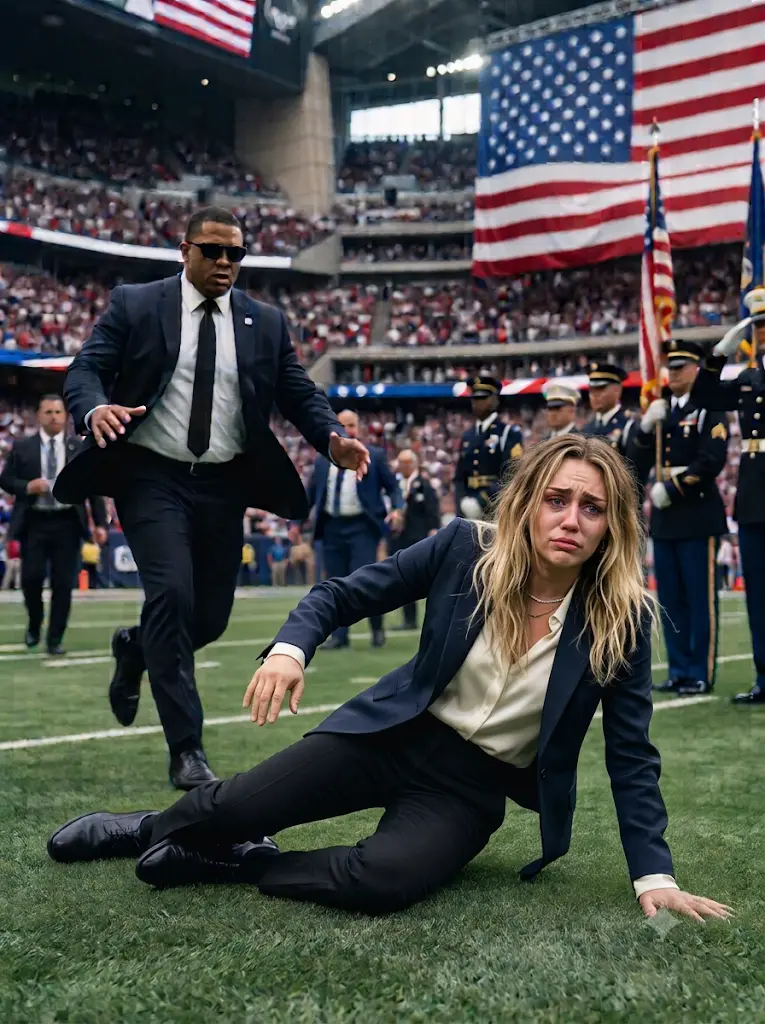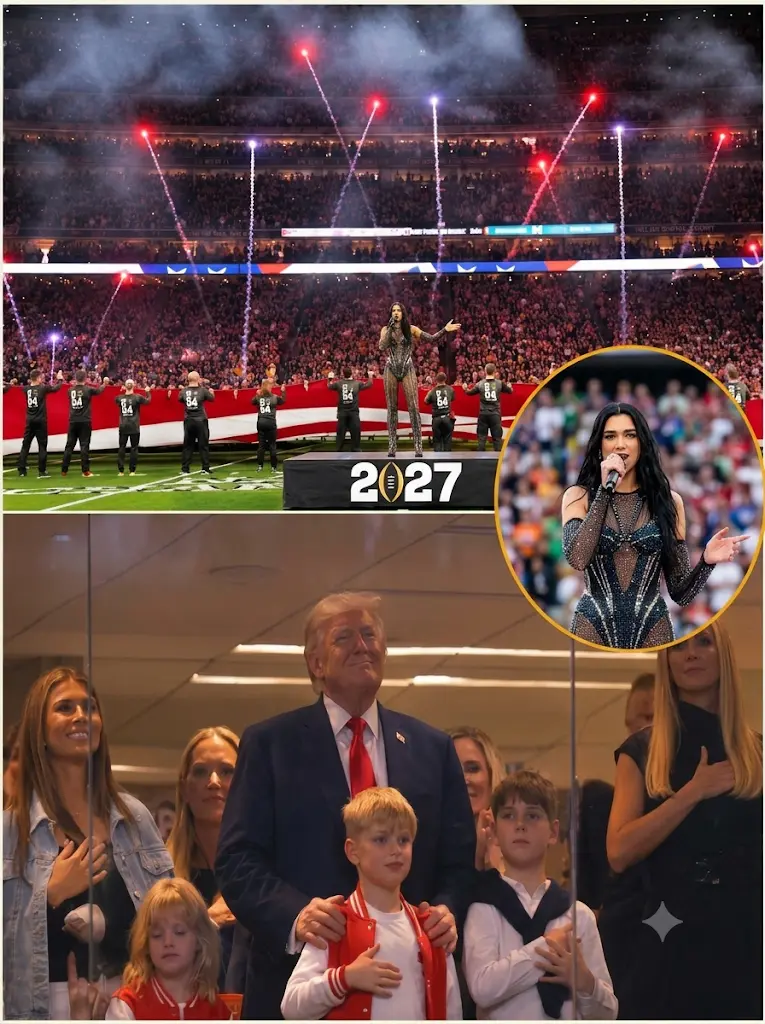
PHENOMENAL DOESN'T EVEN COVER IT: DUA LIPA'S CAPTIVATING VOICE AND THE NATIONAL ANTHEM MOMENT THAT COULD LEAVE AN ENTIRE STADIUM SPEECHLESS
A stadium filled with thousands of spectators. The anticipation of a major sporting event. The American flag rising above the field. And one of the world's most recognizable pop stars standing before a microphone, preparing to deliver one of the most demanding songs in American public life. For Dua Lipa, the image of performing “The Star-Spangled Banner” on such an enormous stage captures everything that makes live music extraordinary: pressure, vulnerability, national tradition, and the power of a single voice.
There is something remarkable about the moments before a major performance.
The crowd is restless. Fans are discussing the game ahead. Cameras sweep across the stadium. Players stand along the sidelines, preparing for the competition that will soon begin.
Then the atmosphere changes.
The conversations fade.
The attention shifts toward the center of the field.
And the performer is left with a challenge that cannot be solved through elaborate choreography or dazzling visual effects.
Just the melody.
Just the lyrics.
Just the voice.
The dramatic account of Dua Lipa delivering an unforgettable national anthem performance presents a compelling image, although it does not identify a verified sporting event, date, or recording. The specific performance and audience reactions described therefore cannot be treated as confirmed.
Nevertheless, the scene raises an interesting question: What would happen if one of contemporary pop music's most distinctive voices brought her artistry to one of the most recognizable ceremonial songs in the world?
To understand the possibilities, it is worth examining the remarkable career that has made Dua Lipa an international superstar.
A VOICE THAT CHANGED THE SOUND OF MODERN POP
Dua Lipa has become one of the defining pop artists of her generation.
Born on August 22, 1995, in London, England, she grew up in a family with Kosovo Albanian roots.
Her parents, Anesa and Dukagjin Lipa, maintained a strong connection to their cultural heritage.
Music was an important part of her upbringing.
Her father was involved in music, and Dua developed an interest in singing from an early age.
As a teenager, she began sharing cover performances online while pursuing opportunities in the music industry.
Her early ambition eventually led to a recording career that would reach audiences across the world.
Today, her voice is instantly recognizable.
Its lower register, rich tone, and controlled delivery distinguish her from many other contemporary pop performers.
She has built a career around songs that combine confidence, emotional expression, and dance-floor energy.
But performing the American national anthem would present a very different challenge from singing a familiar pop hit.
THE MOMENT BEFORE THE FIRST NOTE
A major stadium performance creates an atmosphere unlike almost any other musical setting.
Thousands of people gather in anticipation of an important sporting event.
Television cameras capture the players, spectators, and surrounding spectacle.
The energy is enormous.
But when the national anthem begins, the focus shifts.
The competition has not yet started.
The result remains uncertain.
And for a brief period, the entire venue turns its attention toward one performer.
That transition can be powerful.
A successful national anthem performance does not necessarily require elaborate vocal runs or dramatic reinterpretations.
Sometimes the most memorable approach is restraint.
A singer who allows the melody to breathe can create a stronger emotional connection than one who attempts to overwhelm the audience.
Dua Lipa's controlled vocal style makes the idea particularly intriguing.
Her performances frequently demonstrate an ability to communicate confidence without excessive embellishment.
That quality could serve her well in a ceremonial setting.
NO SECOND TAKE, NO PLACE TO HIDE
Singing “The Star-Spangled Banner” is a demanding assignment.
The melody has a wide vocal range.
Its structure requires careful breath control.
And the final section presents significant technical challenges.
Unlike a studio recording, a live performance offers no opportunity to correct a note afterward.
The singer must deliver the song in real time.
Outdoor stadiums can create additional difficulties.
Sound may echo across the venue.
The performer may hear delayed audio through the sound system.
Weather conditions can affect the experience.
And the knowledge that millions of viewers may be watching can increase the pressure.
Even experienced performers must prepare carefully.
For Dua Lipa, whose career has included international tours, major award ceremonies, and televised performances, the demands of a large audience are familiar.
But the national anthem presents a distinctive test.
Its success depends less on spectacle than on precision, emotional control, and respect for the occasion.
FROM LONDON TO GLOBAL STARDOM
Dua Lipa's rise to international fame was not immediate.
She developed her musical interests while growing up in London and spending part of her childhood in Kosovo.
As a teenager, she returned to London to pursue music.
She worked toward establishing herself in the industry while developing her songwriting and performance skills.
Her determination eventually led to a recording contract with Warner Records.
In 2015, she began releasing music that introduced her to wider audiences.
Her early singles demonstrated a distinctive combination of contemporary pop production and confident vocal delivery.
But her breakthrough would soon arrive on a much larger scale.
NEW RULES AND THE SONG THAT DEFINED A GENERATION
In 2017, Dua released “New Rules.”
The recording became an international hit.
Its lyrics presented a message of independence and emotional self-control following a difficult relationship.
The music video became a major cultural phenomenon.
Its choreography, visual style, and message attracted enormous attention.
“New Rules” reached No. 1 on the UK Singles Chart and became a major success internationally.
The song helped establish Dua as one of pop music's most promising new stars.
It also demonstrated her ability to communicate emotional themes through accessible, energetic music.
That combination of confidence and vulnerability would become central to her artistic identity.
HER DEBUT ALBUM AND THE BEGINNING OF A MAJOR CAREER
Dua released her self-titled debut album in 2017.
The project included songs such as “Be the One,” “IDGAF,” and “New Rules.”
It combined contemporary pop with electronic and dance influences.
The album introduced audiences to her distinctive voice and songwriting perspective.
Its success helped establish her position within the international music industry.
Dua's early career was defined by determination and a willingness to develop her own artistic identity.
Rather than relying solely on visual spectacle, she focused on creating memorable recordings.
Her music resonated with listeners who appreciated its combination of emotional honesty and confidence.
THE GRAMMY AWARDS AND INTERNATIONAL RECOGNITION
At the 2019 Grammy Awards, Dua won Best New Artist.
The achievement represented a major milestone.
It confirmed her emergence as an important figure in contemporary pop music.
She also shared the award for Best Dance Recording for “Electricity,” her collaboration with Silk City.
The recognition demonstrated her growing influence.
But Dua's career was only beginning.
Her next major project would transform her into one of the world's most successful pop performers.
FUTURE NOSTALGIA AND A NEW ERA OF POP MUSIC
In 2020, Dua released Future Nostalgia.
The album became one of the defining pop projects of the decade.
Its sound drew inspiration from disco, funk, and dance-pop traditions.
The project included hits such as “Don't Start Now,” “Physical,” “Break My Heart,” and “Levitating.”
Its production combined retro influences with contemporary energy.
The album received widespread critical acclaim.
It also became a major commercial success.
For many listeners, Future Nostalgia provided an uplifting musical escape during a difficult period in global history.
The project demonstrated Dua's ability to create music that felt both familiar and new.
DON'T START NOW AND THE POWER OF CONFIDENCE
“Don't Start Now” became one of Dua's most successful singles.
The recording combined disco-inspired production with a message of emotional independence.
Its confident delivery helped establish a new musical direction.
The song became an international hit.
It also demonstrated Dua's growing command of live performance.
Her appearances during the Future Nostalgia era showcased increasingly ambitious choreography and stage production.
But the recording's success ultimately depended on the strength of the song and her vocal identity.
LEVITATING AND THE SOUND OF GLOBAL CELEBRATION
“Levitating” became another defining recording of Dua's career.
Its energetic production and memorable melody attracted audiences around the world.
The song became one of the biggest hits of the Future Nostalgia era.
Its popularity reinforced Dua's ability to create music that crossed cultural and geographic boundaries.
The recording also demonstrated the lasting appeal of dance-oriented pop.
For many listeners, it became associated with celebration, optimism, and confidence.
THE ART OF PERFORMING WITHOUT OVERDOING IT
Dua's vocal style is different from that of performers known primarily for elaborate vocal acrobatics.
Her strength often lies in tone, control, and rhythmic precision.
She uses her lower register to create a distinctive sound.
Her phrasing can communicate confidence without requiring excessive ornamentation.
That approach could be particularly effective in a national anthem performance.
The song is already emotionally significant.
It does not need to be transformed into an elaborate vocal competition.
A restrained