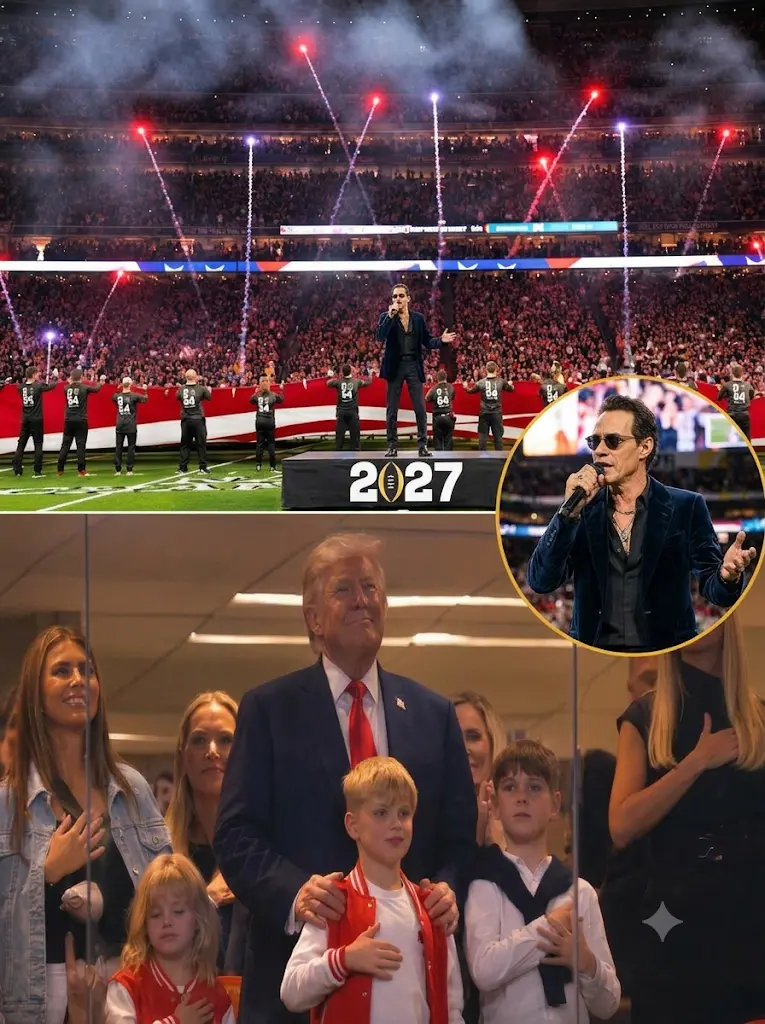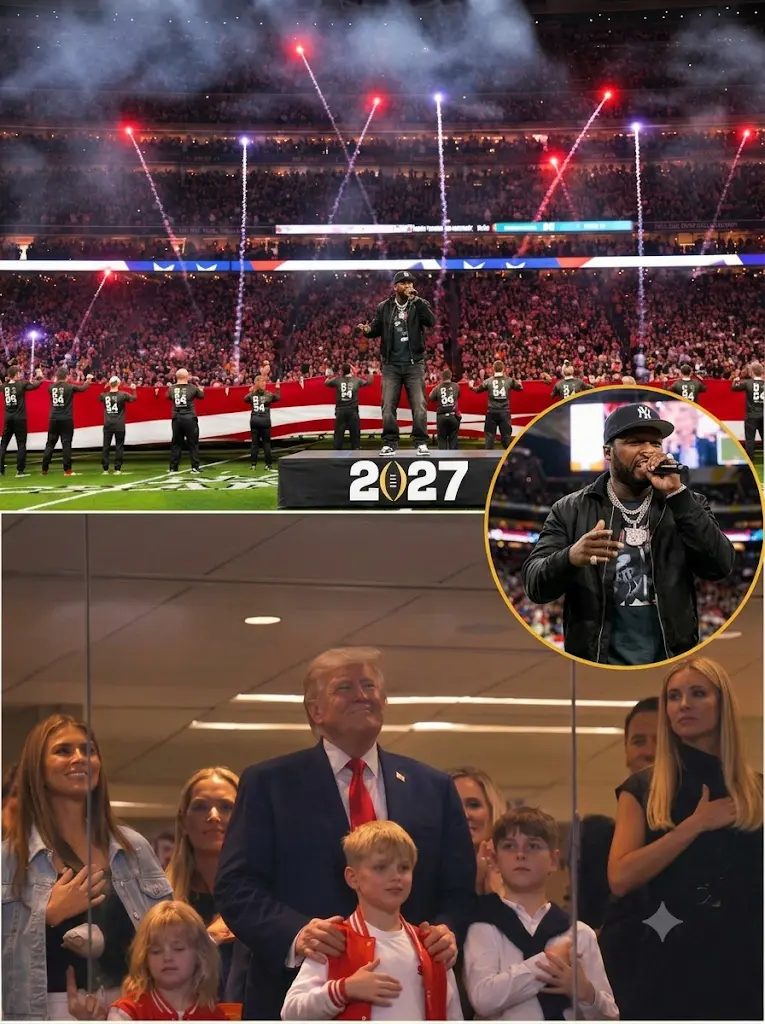
PHENOMENAL DOESN'T EVEN COVER IT: 50 CENT AND THE NATIONAL ANTHEM MOMENT THAT COULD LEAVE AN ENTIRE STADIUM SPEECHLESS
A stadium packed with thousands of spectators. The anticipation of a major sporting event. The American flag displayed above the field. And one of hip-hop's most recognizable figures standing alone before a microphone, preparing to deliver “The Star-Spangled Banner.” For Curtis “50 Cent” Jackson, the image represents a striking departure from the hard-hitting rap performances that made him famous — and a fascinating test of musical versatility, confidence, and emotional expression.
There are moments in entertainment when everything seems to stop.
The crowd grows quieter.
The cameras focus on a single performer.
The noise of the stadium gives way to anticipation.
And suddenly, the enormous spectacle of a major sporting event becomes something deeply personal.
One artist.
One microphone.
One song.
No elaborate production.
No opportunity for a second take.
Just the challenge of delivering one of the most recognizable songs in American history before an audience that may include millions of television viewers.
The dramatic account of 50 Cent delivering an unforgettable national anthem performance creates a compelling scene. However, it does not identify a verified sporting event, date, or recording, and the specific performance and audience reactions described cannot be treated as established facts.
Still, the scenario raises an intriguing question: What would it mean for one of hip-hop's most influential artists to step outside his familiar musical identity and attempt a demanding ceremonial song?
The answer begins with the extraordinary career that made 50 Cent a global entertainment figure.
FROM QUEENS TO INTERNATIONAL SUPERSTARDOM
Curtis James Jackson III, professionally known as 50 Cent, was born on July 6, 1975, in Queens, New York.
He grew up in South Jamaica, a neighborhood that would later become central to his musical identity.
His early life was marked by significant challenges.
His mother, Sabrina, died when he was young, and he was raised by his grandparents.
Those experiences influenced the themes of survival, ambition, and resilience that would later define his music.
Before becoming internationally famous, Jackson developed his skills as a rapper within New York's competitive hip-hop environment.
His early recordings attracted attention for their direct storytelling and distinctive delivery.
But his journey toward mainstream success was far from straightforward.
He encountered professional setbacks and personal adversity before achieving his breakthrough.
Those experiences helped shape the determined public persona that became central to his career.
THE VOICE THAT HELPED DEFINE AN ERA
50 Cent's musical identity is immediately recognizable.
His delivery combines rhythmic precision, controlled intensity, and an unmistakable vocal tone.
Unlike performers whose reputations are built primarily on elaborate singing techniques, Jackson became famous through rap.
His strengths include timing, phrasing, storytelling, and the ability to communicate confidence through relatively restrained delivery.
Those qualities helped make his recordings memorable.
Songs such as “In da Club,” “21 Questions,” “P.I.M.P.,” and “Many Men (Wish Death)” became defining hits of his early career.
His voice carried a distinctive mixture of authority and emotional distance.
At times, his performances communicated vulnerability beneath the confident exterior.
That contrast became one of his artistic trademarks.
But singing the American national anthem would require a different set of technical skills.
THE MOMENT BEFORE THE FIRST NOTE
A major stadium event creates an atmosphere unlike almost any other performance setting.
Thousands of spectators arrive with excitement.
Fans wear team colors.
Music plays through the speakers.
Cameras capture the crowd.
Players prepare for the competition ahead.
Then the national anthem ceremony begins.
The atmosphere changes.
The focus shifts from the sporting event to the performer.
For a brief period, the stadium becomes a shared ceremonial space.
The singer stands before an audience that already knows the melody.
Every phrase carries expectation.
For a rapper whose career has been defined by powerful beats and rhythmic delivery, the challenge would be particularly distinctive.
The performance would require melodic control rather than primarily rhythmic expression.
That transition would be central to the experience.
NO SECOND TAKE, NO PLACE TO HIDE
“The Star-Spangled Banner” is a demanding song.
Its melody spans a wide vocal range.
The opening phrases require careful breath control.
The final section presents significant technical challenges.
Unlike a studio recording, a live stadium performance unfolds in real time.
There is no opportunity to correct a note afterward.
The performer must manage nerves, timing, and pitch while maintaining the emotional character of the song.
Outdoor stadium acoustics can create additional difficulties.
Sound may echo across the venue.
The performer may hear delayed audio through the sound system.
Weather conditions can affect the experience.
Even accomplished singers must prepare carefully.
For 50 Cent, whose established musical strengths are primarily rooted in rap rather than traditional vocal performance, such a challenge would require substantial preparation.
THE BREAKTHROUGH THAT CHANGED HIP-HOP
50 Cent's rise to mainstream success accelerated through his association with Eminem and Dr. Dre.
After attracting attention with his music, he signed with Shady Records and Aftermath Entertainment.
The partnership helped introduce him to a much larger audience.
In 2003, he released Get Rich or Die Tryin'.
The album became a commercial phenomenon.
Its combination of hard-hitting production, memorable hooks, and vivid storytelling helped define the sound of mainstream hip-hop during the early 2000s.
The project included “In da Club,” “21 Questions,” “P.I.M.P.,” and “Many Men (Wish Death).”
Its success transformed Jackson into an international superstar.
The album remains one of the most recognizable releases of its era.
IN DA CLUB AND THE SOUND OF A GENERATION
“In da Club” became 50 Cent's signature hit.
Produced by Dr. Dre and Mike Elizondo, the recording combined a memorable beat with Jackson's distinctive delivery.
The song reached No. 1 on the Billboard Hot 100.
Its popularity extended far beyond traditional hip-hop audiences.
The recording became a defining soundtrack for parties, celebrations, and popular culture.
Its success demonstrated Jackson's ability to communicate confidence through a relatively controlled performance.
Rather than relying on elaborate vocal techniques, he used rhythm and personality to command attention.
That ability to connect with an audience would be valuable in almost any live setting.
But performing the national anthem would require him to apply his stage confidence to a very different musical form.
MANY MEN AND THE EMOTIONAL SIDE OF HIS MUSIC
“Many Men (Wish Death)” remains one of the most emotionally powerful recordings in 50 Cent's catalog.
The song reflects themes of survival, danger, and personal adversity.
Its dramatic production and direct lyrics helped establish the emotional depth of his early work.
Although Jackson is often associated with confidence and confrontation, his music has also explored vulnerability.
That emotional complexity contributed to his success.
Listeners connected with the sense of determination beneath his public persona.
A ceremonial performance would present an opportunity to communicate emotion without relying on the storytelling structure of a rap song.
It would require a different form of musical expression.
THE MASSACRE AND CONTINUED COMMERCIAL SUCCESS
In 2005, 50 Cent released The Massacre.
The album included hits such as “Candy Shop,” “Just a Lil Bit,” and “Disco Inferno.”
Its commercial success reinforced his position as one of hip-hop's biggest stars.
Jackson continued releasing music and collaborating with other artists.
His influence extended through G-Unit, the hip-hop collective associated with his career.
The group's success helped introduce additional performers to mainstream audiences.
By the middle of the decade, 50 Cent had become one of the most recognizable figures in popular music.
His reputation was built on more than individual songs.
He had developed a complete entertainment identity.
THE ART OF COMMANDING A CROWD
One of 50 Cent's greatest strengths as a performer is his stage presence.
His concerts rely on confidence, rhythmic precision, and direct audience engagement.
He understands how to create anticipation.
He knows how to use pauses.
And he has spent decades performing before large crowds.
Those skills are important in live entertainment.
But a national anthem performance would require a different kind of command.
Instead of encouraging the audience to dance or sing along, the performer would need to create a respectful atmosphere.
The goal would not be to generate excitement through a beat.
It would be to communicate the significance of a familiar ceremonial song.
THE DIFFERENCE BETWEEN RAP AND TRADITIONAL SINGING
Rap and singing share certain musical foundations.
Both require rhythm.
Both involve phrasing and breath control.
Both can communicate emotion.
But traditional melodic singing places additional demands on pitch and sustained notes.
A rapper may demonstrate extraordinary rhythmic skill without possessing the vocal range required for a demanding anthem.
Likewise, a technically accomplished singer may struggle with the rhythmic precision of rap.
The two disciplines are related but distinct.
For 50 Cent, the challenge of performing “The Star-Spangled Banner” would therefore be substantial.
His experience as a rapper would provide confidence and stage awareness.
But melodic preparation would remain essential.
THE NATIONAL ANTHEM AND ITS CULTURAL SIGNIFICANCE
“The Star-Spangled Banner” occupies an important place in American public life.
Its lyrics were written by Francis Scott Key in 1814.
The song became the official national anthem of the United States in 1931.
Today, it is performed at sporting events, national ceremonies, and public commemorations.
For many listeners, it represents patriotism, remembrance, and shared national identity.
Its performance can also carry personal significance.
Some spectators associate the song with military service.
Others connect it with family traditions or important national experiences.
A performer must recognize that the anthem may hold different meanings for different audience members.
That responsibility extends beyond technical ability.
It requires sensitivity to the occasion.
HIP-HOP AND AMERICAN CULTURAL IDENTITY
Hip-hop is one of the most influential cultural movements to emerge from the United States.
Originating in New York City during the 1970s, it developed into a global form of artistic expression.
The genre has shaped music, fashion, language, and popular culture.
50 Cent became one of its defining commercial figures during the early 2000s.
His success reflected the growing international influence of American hip-hop.
The idea of a major rapper performing the national anthem brings together two different aspects of American musical culture.
One represents a longstanding national ceremony.
The other reflects a modern artistic tradition rooted in urban communities.
A thoughtful performance could highlight the diversity of American musical expression.
WHEN A STADIUM BECOMES COMPLETELY STILL
A stadium is normally filled with noise.
Fans cheer.
Conversations fill the stands.
Music plays through the speakers.
The atmosphere is energetic and unpredictable.
But a powerful ceremonial performance can transform that environment.
Thousands of spectators may turn their attention toward a single voice.
The result can feel remarkably intimate.
Every note becomes important.
Every pause creates anticipation.
For 50 Cent, whose concerts are usually associated with energetic hip-hop performances, such a moment would represent a striking contrast.
The audience would not be responding to a familiar beat.
It would be listening to the performance itself.
THE IMPORTANCE OF RESTRAINT
One of the most important qualities in a successful national anthem performance is restraint.
The song does not necessarily benefit from excessive embellishment.
A simple interpretation can sometimes communicate greater sincerity.
A carefully controlled phrase may be more effective than an elaborate vocal run.
A quiet moment can create anticipation.
And a natural progression can make the final note feel earned.
50 Cent's musical style has often relied on controlled delivery.
His recordings demonstrate that a performer does not always need to shout to command attention.
That principle could be valuable in a ceremonial setting.
But it would need to be combined with the melodic control required by the song.
FROM MUSIC TO HOLLYWOOD
50 Cent's career has extended far beyond recording music.
In 2005, he starred in the film Get Rich or Die Tryin'.
The project drew inspiration from aspects of his life.
It introduced him to audiences as a leading actor.
He later