PHENOMENAL DOESN'T EVEN COVER IT: MARC ANTHONY'S POWERFUL VOICE AND THE NATIONAL ANTHEM MOMENT THAT COULD LEAVE AN ENTIRE STADIUM SPEECHLESS
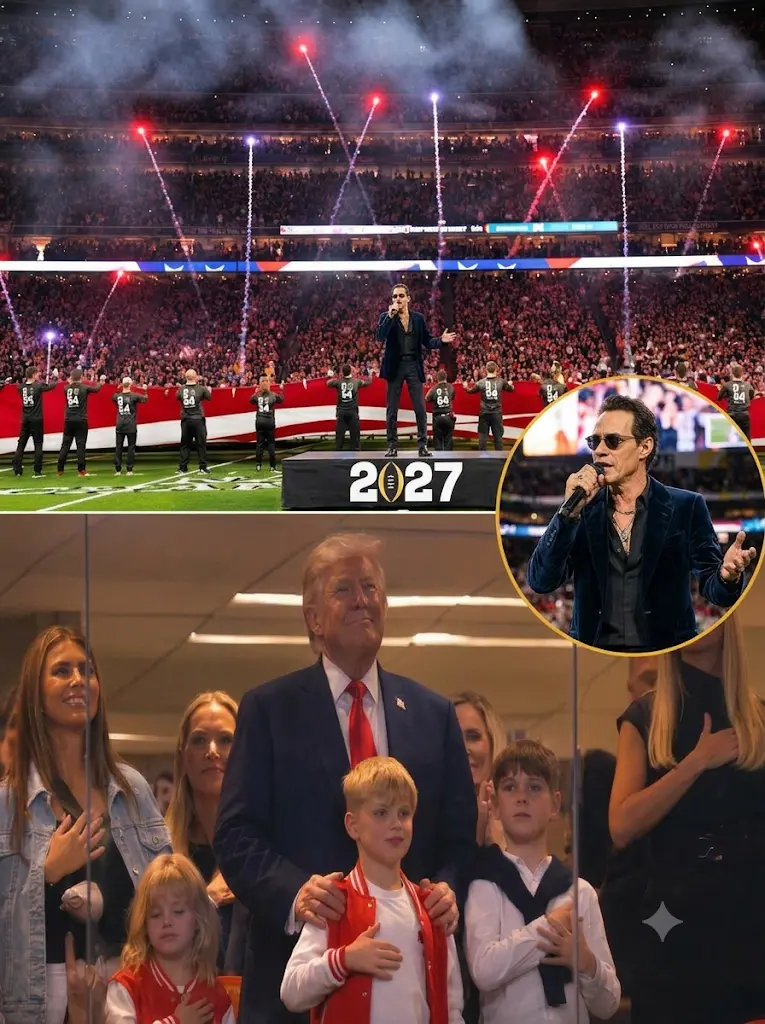
A stadium filled with thousands of spectators. The anticipation of a major sporting event. The American flag standing proudly above the field. And one of Latin music's most recognizable voices stepping toward the microphone. For Marc Anthony, the thought of performing “The Star-Spangled Banner” on such an enormous stage captures everything that makes live music unforgettable: pressure, emotion, national pride, and the extraordinary power of a single human voice.
The image is compelling.
A crowd that moments earlier had been filled with conversations and excitement begins to fall silent. Cameras turn toward the performer. Players stand along the sidelines. Millions of viewers prepare for the opening moments of a highly anticipated sporting event.
And then comes the music.
There are no elaborate dance routines to distract from the performance. No complicated production effects to hide behind. Just the unmistakable voice of Marc Anthony and one of the most recognizable songs in American history.
It is the kind of performance that, when delivered with sincerity and control, can transform an ordinary pregame tradition into something unforgettable.
Although the account describing this particular Marc Anthony anthem performance does not identify a verified event, date, or recording, the scene reflects a powerful question: What happens when an internationally celebrated singer brings decades of musical experience to one of the most demanding stages in entertainment?
The answer begins with understanding the artist himself.
A VOICE THAT HAS ALREADY CONQUERED THE WORLD
Marc Anthony is no ordinary performer.
Born Marco Antonio Muñiz on September 16, 1968, in New York City, the singer has spent decades establishing himself as one of the most influential figures in Latin music.
His career has crossed musical genres, languages, and international borders.
From salsa to romantic ballads and English-language pop, Anthony has demonstrated an extraordinary ability to communicate emotion through music.
His voice is instantly recognizable.
It carries a distinctive combination of intensity, vulnerability, and dramatic expression.
For longtime listeners, that voice has accompanied celebrations, heartbreaks, weddings, family gatherings, and unforgettable personal memories.
Songs such as “Vivir Mi Vida,” “Ahora Quién,” “Valió la Pena,” and “You Sang to Me” have helped define his musical legacy.
But performing the national anthem presents a very different challenge from singing a familiar hit.
There is no opportunity to rely on audience participation.
There is no chorus of fans singing along to cover a difficult note.
And there is no second take.
The performer must deliver every phrase with precision while maintaining the emotional dignity of the occasion.
That is what makes the prospect of Marc Anthony performing “The Star-Spangled Banner” so fascinating.
WHEN AN ENTIRE STADIUM WAITS FOR ONE VOICE
A major sporting event creates a unique atmosphere.
Long before the opening whistle, kickoff, or first pitch, spectators are already immersed in excitement.
The stadium is filled with movement.
Fans take photographs, wave flags, and discuss the competition ahead.
Players prepare mentally for the challenge.
Television cameras move across the crowd.
Then the national anthem begins.
The atmosphere changes.
For a brief moment, the competition itself becomes secondary.
The focus shifts from athletic achievement to a shared ceremonial experience.
This transition creates an enormous responsibility for the singer.
The national anthem is familiar to millions of Americans, and audiences often have strong expectations about how it should sound.
Some prefer a traditional interpretation.
Others appreciate an expressive performance that introduces subtle musical individuality.
The challenge is finding a balance between artistic expression and respect for the song.
Marc Anthony's musical background makes that balance particularly interesting.
His career has been built on emotional interpretation, powerful phrasing, and the ability to make familiar melodies feel deeply personal.
NO SAFETY NET, NO SECOND TAKE
One of the most demanding aspects of singing the national anthem is the absence of room for error.
Unlike a studio recording, a live stadium performance happens in real time.
The singer must manage nerves, breathing, timing, and pitch while performing before a large audience.
Outdoor venues can create additional difficulties.
Sound may echo across the stadium.
Wind and weather can affect the experience.
A performer may hear delayed audio through the sound system.
And the emotional pressure of the occasion can make even familiar notes feel challenging.
“The Star-Spangled Banner” is particularly demanding because of its wide vocal range.
Its melody moves between relatively low notes and powerful high passages.
The final section requires control, endurance, and confidence.
For a singer whose career has included demanding salsa performances and emotionally intense ballads, these challenges are familiar in some respects.
But the national anthem remains a distinctive test.
It requires the performer to communicate meaning without allowing technical difficulty to overwhelm the song.
WHY MARC ANTHONY'S VOICE IS DIFFERENT
Marc Anthony has built his reputation on much more than vocal strength.
His greatest asset may be his ability to communicate emotion.
Throughout his career, he has demonstrated that a song does not need excessive embellishment to become powerful.
Sometimes a carefully controlled phrase can carry more emotional weight than an elaborate vocal run.
Sometimes a moment of restraint can be more memorable than a dramatic climax.
That quality is particularly valuable in ceremonial performances.
The national anthem is not simply an opportunity to demonstrate vocal range.
It is a moment that calls for dignity and sincerity.
A successful interpretation must allow the meaning of the song to remain central.
Anthony's experience with romantic ballads and salsa gives him a broad expressive vocabulary.
He understands how to build intensity.
He knows how to use pauses.
And he has spent decades learning how to connect with audiences through the smallest changes in vocal delivery.
These qualities could make his interpretation especially compelling.
THE SILENCE THAT SPEAKS LOUDER THAN APPLAUSE
Some of the most memorable live performances are defined not by the noise they create, but by the silence they inspire.
In a stadium, silence can be extraordinary.
Thousands of people who were speaking moments earlier suddenly direct their attention toward a single performer.
The atmosphere becomes focused.
Every note feels more significant.
Every pause carries anticipation.
The national anthem has the ability to create precisely that kind of shared experience.
When a singer delivers it with conviction, spectators may briefly forget the competition they came to watch.
The music becomes the center of attention.
For an artist such as Marc Anthony, whose performances often rely on emotional connection, this environment offers a powerful opportunity.
The most memorable interpretation would not necessarily be the loudest.
It would be the one that makes listeners feel the significance of the moment.
FROM THE STREETS OF NEW YORK TO INTERNATIONAL SUPERSTARDOM
Anthony's musical journey began far from the enormous international stages he would eventually command.
Growing up in New York City in a Puerto Rican family, he was exposed to different musical traditions.
His father, Felipe Muñiz, was also a musician and introduced him to music at an early age.
Anthony developed an appreciation for Latin rhythms, romantic songwriting, and the expressive traditions of salsa.
He began his professional career working in dance and freestyle music.
Over time, he moved toward salsa, the genre that would transform his career.
His 1993 album Otra Nota helped establish him as a major emerging artist.
The follow-up, Todo a Su Tiempo, strengthened his reputation.
By the late 1990s, he had become one of the most important voices in contemporary salsa.
His music reached audiences across Latin America, the United States, and beyond.
The success was not accidental.
It was the result of years of performance, experimentation, and artistic development.
THE SALSA KING WHO LEARNED TO COMMAND EVERY STAGE
Salsa is an especially demanding musical genre.
Its rhythms require precision.
Its arrangements often involve powerful brass sections, complex percussion, and rapid changes in intensity.
The singer must maintain control while interacting with a large ensemble.
Marc Anthony became known for his ability to thrive in that environment.
His performances combined technical skill with dramatic emotional expression.
He could move from a restrained opening phrase to a powerful climax without losing the character of the song.
That experience helped prepare him for major international stages.
He learned how to command attention.
He learned how to respond to an audience.
And he learned that the strongest performances often depend on emotional authenticity rather than spectacle.
Those lessons would be valuable in almost any musical setting, including a national anthem ceremony.
THE ENGLISH-LANGUAGE BREAKTHROUGH
In 1999, Anthony expanded his mainstream reach with an English-language album bearing his name.
The project included hits such as “I Need to Know” and “You Sang to Me.”
These recordings introduced his voice to audiences who were less familiar with his Spanish-language catalog.
The transition demonstrated his versatility.
He could deliver energetic Latin pop.
He could perform romantic ballads.
And he could communicate powerful emotions in both English and Spanish.
This crossover success strengthened his international reputation.
It also positioned him as an artist capable of connecting with diverse audiences.
A national anthem performance at a major American sporting event would represent another opportunity to bring those musical worlds together.
MORE THAN A SONG: THE MEANING OF THE NATIONAL ANTHEM
“The Star-Spangled Banner” occupies a distinctive place in American public life.
Its lyrics were written by Francis Scott Key in 1814.
The song later became the official national anthem of the United States in 1931.
Today, it is performed at sporting events, public ceremonies, and national commemorations.
For many listeners, it represents patriotism, remembrance, and shared national identity.
Its performance can also carry personal meaning.
Some spectators associate it with family members who served in the military.
Others connect it with important national memories.
For immigrants and their descendants, it may evoke the complexity of belonging to a country shaped by different cultures and experiences.
Marc Anthony's Puerto Rican heritage and New York upbringing add another dimension to the discussion.
His career reflects the influence of Latin culture within American music.
His success demonstrates how artistic traditions can cross linguistic and cultural boundaries.
That background makes the idea of his voice carrying the national anthem particularly meaningful.
REPRESENTING TWO MUSICAL WORLDS
Marc Anthony's career has often existed at the intersection of Latin and American popular music.
He has celebrated Puerto Rican musical traditions while achieving success throughout the United States.
His songs have reached audiences who speak different languages.
His concerts bring together people from different cultural backgrounds.
And his musical identity reflects the diversity of contemporary American entertainment.
A major national anthem performance would provide an opportunity to highlight that shared cultural experience.
The significance would not depend on changing the song's meaning.
Instead, it would come from the artist bringing his own history and musical perspective to a familiar national tradition.
In that sense, the performance could represent more than a technical achievement.
It could become a moment of cultural connection.
WHY SPORTS AND MUSIC CREATE UNFORGETTABLE MOMENTS
Sporting events are built around anticipation.
Fans gather to witness competition, determination, and the possibility of extraordinary achievement.
Music can intensify those emotions.
A powerful pregame performance can establish the atmosphere for everything that follows.
The national anthem is especially important because it arrives at the threshold of the event.
The competition has not yet begun.
The outcome remains uncertain.
The stadium is filled with expectation.
A memorable musical performance can transform that anticipation into a shared emotional experience.
For a few minutes, supporters of opposing teams stand together and listen to the same song.
The moment belongs to everyone in attendance.
THE CHALLENGE OF MAKING A FAMILIAR SONG FEEL NEW
One of the greatest challenges for any singer performing “The Star-Spangled Banner” is familiarity.
Most audience members already know the melody.
Many have heard it performed hundreds of times.
That familiarity creates strong expectations.
An interpretation that changes too much may distract from the occasion.
But a performance that feels mechanical may fail to connect emotionally.
The most successful singers often find a middle ground.
They preserve the recognizable structure while introducing subtle elements of their own musical personality.
Marc Anthony's phrasing could be particularly effective in that setting.
His experience with romantic ballads has taught him how to shape a melody without overwhelming it.
His salsa background has given him an instinctive understanding of rhythm.
And his decades of live performance have strengthened his ability to communicate with large audiences.
THE FINAL NOTE: WHERE EVERYTHING COMES TOGETHER
The closing passage of the national anthem is one of its most demanding sections.
The melody rises toward a climactic conclusion.
The singer must maintain breath support and vocal control.
At the same time, the performance must retain emotional meaning.
This is where technical ability and artistic judgment become inseparable.
A powerful final note can create an unforgettable impression.
But the moment is most effective when the entire performance has built naturally toward it.
The audience should feel that the conclusion is earned.
For a performer such as Anthony, whose career has been defined by dramatic musical storytelling, this kind of progression is familiar.
He understands how to create anticipation and release.
That ability has helped make his concerts memorable for decades.
THE DIFFERENCE BETWEEN VOCAL POWER AND TRUE ARTISTRY
A powerful voice can impress an audience.
But genuine artistry requires something more.
It requires interpretation.
It requires restraint.
And it requires an understanding of the emotional meaning behind the music.
Marc Anthony's career offers numerous examples of those qualities.
His most beloved recordings are not remembered solely because of their technical difficulty.
They are remembered because of the feelings they communicate.
Listeners connect with the longing in his romantic ballads.
They respond to the energy of his salsa performances.
And they recognize the confidence of an artist who has spent decades developing his craft.
A national anthem performance would offer another setting in which those qualities could shine.
WHY THE BIGGEST STAGE CAN REVEAL AN ARTIST'S CHARACTER
Major public performances are not simply tests of musical skill.
They also reveal how an artist responds to pressure.
A stadium audience can be intimidating.
Television broadcasts add another layer of scrutiny.
Every note may be recorded, replayed, and discussed.
But experienced performers learn to focus on the music rather than the size of the audience.
Anthony has spent decades performing before enormous crowds.
He has appeared at major award ceremonies.
He has toured internationally.
And he has collaborated with some of the music industry's most recognizable figures.
Those experiences have helped establish his confidence as a live performer.
Still, the simplicity of a national anthem ceremony creates a distinctive challenge.
Without elaborate staging, the singer's voice becomes the entire performance.
THE LEGACY OF AN ARTIST WHO NEVER STOPPED EVOLVING
Marc Anthony's career has lasted through major changes in the music industry.
He emerged during an era when physical albums dominated the market.
He experienced the growth of music television and international crossover hits.
He adapted to digital streaming and the global expansion of Latin music.
Throughout those changes, his voice remained central to his success.
He has continued recording, touring, and performing for audiences around the world.
His influence can be heard in the work of younger Latin artists.
His success also helped demonstrate that Spanish-language music could command international attention.
That legacy is already substantial.
He does not need a single stadium performance to establish his importance.
But an extraordinary interpretation of a familiar song could introduce another memorable chapter to his public story.
WHAT MAKES A PERFORMANCE TRULY PHENOMENAL?
The word “phenomenal” is frequently used in entertainment.
It appears in reviews, headlines, and social media reactions.
But truly exceptional performances are relatively rare.
They require several elements to come together.
The artist must possess the necessary technical ability.
The material must suit the performer's strengths.
The setting must create emotional significance.
And the delivery must feel authentic.
When those elements align, the result can become more than entertainment.
It can become a shared memory.
A stadium anthem performance has the potential to create that kind of experience because it combines national tradition, public anticipation, and the vulnerability of live music.
The performer stands alone.
The audience listens.
And the outcome depends on the next note.
THE IMPORTANCE OF DISTINGUISHING THE STORY FROM A VERIFIED EVENT
The dramatic account of Marc Anthony stepping into a stadium spotlight is compelling, but it does not identify a specific sporting event, date, broadcast, or authenticated recording.
That distinction matters.
Without those details, the account cannot establish that the particular performance and audience reactions described actually occurred.
It would therefore be premature to claim that a stadium fell silent, that millions witnessed a specific performance, or that spectators responded in a particular way.
What can be discussed with confidence is Anthony's established musical ability and the artistic demands of performing the American national anthem.
Those facts provide a meaningful foundation for understanding why such a performance could be memorable.
They also highlight the importance of verifying the circumstances before presenting a dramatic account as a documented event.
WHY MARC ANTHONY'S STORY CONTINUES TO INSPIRE
Marc Anthony's success represents more than record sales or industry awards.
His career reflects persistence, cultural pride, and artistic commitment.
He built his reputation through years of demanding performances.
He introduced salsa to new audiences.
He expanded his reach through English-language recordings.
And he maintained a recognizable musical identity while exploring different styles.
For aspiring singers, his journey demonstrates the value of developing a distinctive voice.
For longtime fans, his music represents decades of emotional memories.
And for audiences encountering his work for the first time, his performances offer an introduction to the expressive power of Latin music.
That is why the idea of Anthony standing alone before a massive stadium feels so compelling.
The setting would strip away much of the spectacle associated with international superstardom.
What remained would be the element that made him famous in the first place.
His voice.
FINAL THOUGHTS: SOMETIMES THE BIGGEST MOMENTS NEED ONLY ONE VOICE
There are performances that entertain.
There are performances that impress.
And then there are performances that remind audiences why music matters.
The image of Marc Anthony standing before a packed stadium, preparing to sing “The Star-Spangled Banner,” captures the possibility of that third kind of experience.
No elaborate choreography.
No extravagant production.
No opportunity for a second take.
Just a singer, a familiar melody, and an audience waiting