🚨🏀 “YOU LOST, AND YOU’RE STILL TALKING!” — A Viral A’ja Wilson–Caitlin Clark Clash Suddenly Pulls Michael Jordan Into the Firestorm, but the Alleged “15-Minute Response” Has One Huge Problem 👀🔥
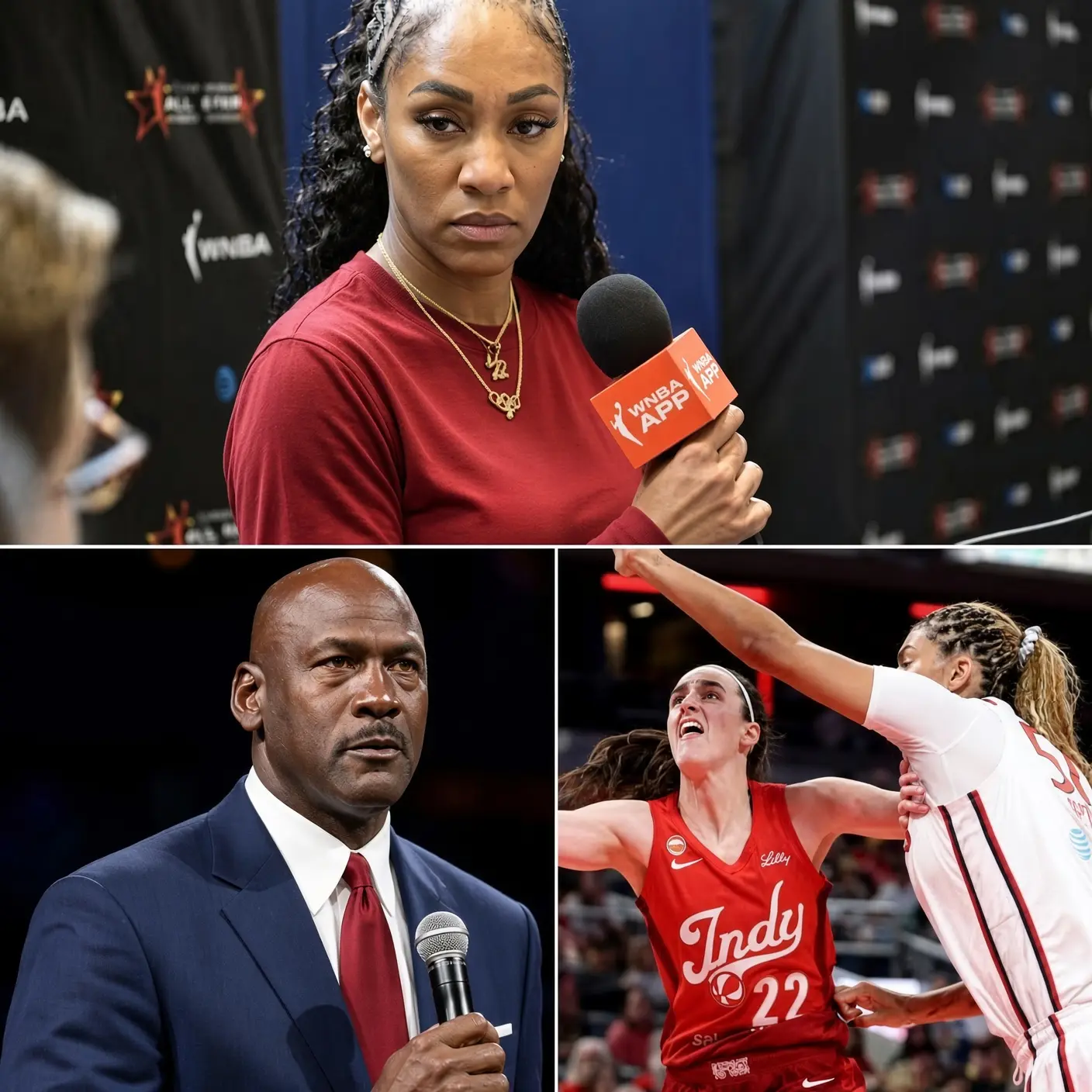
A dramatic WNBA story involving A'ja Wilson, Caitlin Clark and Michael Jordan is exploding across social media — combining three of basketball's most recognizable names into one supposed confrontation.
The story has everything required for a viral sports feud.
A provocative quote.
A playoff rivalry.
An alleged shot at Clark.
A reference to Team USA.
And finally, Michael Jordan supposedly entering the argument only 15 minutes later with a devastating response.
There is only one major problem.
The most explosive pieces of the story have not been reliably authenticated.
No credible transcript, verified video or established report currently confirms Wilson telling Clark, “You lost, and you're still talking!”
The longer statement attributed to Wilson — claiming contact is unavoidable and suggesting players had actually “gone easier” on Clark because she was Wilson's junior from Team USA — also lacks reliable sourcing.
And perhaps most importantly, there is no authenticated public statement showing Michael Jordan firing back at Wilson 15 minutes later.
That distinction matters.
Because there is already enough genuine tension, physicality and debate surrounding WNBA basketball without inventing a confrontation that may never have happened.
What makes the claim believable to many fans is that Wilson and Clark naturally occupy the center of modern WNBA discussion.
Wilson is one of the defining players of her generation.
Her résumé includes multiple MVP awards, championships, elite defensive recognition and years of dominance with the Las Vegas Aces.
Clark represents a different phenomenon.
Her extraordinary college career at Iowa followed by her arrival in Indiana helped accelerate unprecedented attention around women's basketball.
Every Clark game became a national discussion.
Every hard foul became a debate.
Every officiating decision generated thousands of comments.
Every interaction with another superstar could become content within minutes.
That environment creates fertile ground for fabricated quotes.
Take a real rivalry.
Add an emotional line.
Attach it to a recognizable player.
Then introduce Michael Jordan.
Suddenly, a rumor can travel faster than the original game footage.
The supposed Wilson quote is particularly explosive because of what it implies.
The line claims Wilson dismissed a physical hit as ordinary basketball before suggesting Clark was actually receiving lighter treatment because of their Team USA connection.
If Wilson had genuinely made such a statement publicly, it would be significant.
It could reasonably generate questions about player safety, competitive respect and whether opponents intentionally adjust physicality around certain players.
But those implications are exactly why the quote requires evidence.
A statement that serious should not be attributed to a real athlete simply because it appears in a viral graphic.
The alleged Jordan response presents an even larger credibility problem.
Michael Jordan's name has repeatedly been attached to viral WNBA stories because his status instantly increases the emotional stakes.
If Jordan criticizes someone, the story feels bigger.
If Jordan defends Clark, the story becomes basketball royalty supposedly intervening on behalf of the sport's most visible young star.
But a compelling narrative is not evidence.
There is currently no reliable basis for supplying the “fiery response” promised by the circulating claim.
Inventing one would cross an important line.
It would turn a rumor about Jordan into a fabricated quotation from Jordan.
So what can actually be discussed?
The real basketball debate underneath the viral story.
WNBA games have become increasingly physical, especially when defenses attempt to disrupt elite offensive players.
Clark's style creates difficult defensive decisions.
Her shooting range stretches defenders far beyond the three-point line.
Her passing punishes aggressive traps.
Her transition play can turn a defensive rebound into an opportunity before opponents are organized.
Teams therefore try to make her uncomfortable.
They crowd her.
They bump cutters.
They fight over screens.
They force her toward help.
They attempt to deny easy rhythm.
That is basketball.
But there is always a line between legitimate physical defense and unnecessary contact.
Determining where that line sits is the responsibility of officials and, when necessary, league disciplinary procedures.
The same standard applies to Wilson.
She is extraordinarily difficult to defend because of her combination of strength, footwork, touch and positioning.
Opponents cannot simply allow her to establish comfortable spots near the basket.
They use bodies.
They contest aggressively.
They attempt to force her away from preferred areas.
Wilson has therefore spent much of her career absorbing contact as well as initiating it.
That shared reality makes a hypothetical Wilson–Clark debate about physicality interesting.
Both understand what happens when a defense's game plan revolves around stopping one superstar.
But understanding physical basketball does not authenticate the specific words attributed to Wilson.
The Team USA component of the viral claim is equally designed to intensify the story.
Wilson and Clark have both been central names in American women's basketball conversations, but describing Clark simply as Wilson's “junior from Team USA” inside an alleged hostile quote creates a personal dynamic that needs actual sourcing.
Without a verified recording, transcript or reliable report, fans should not assume Wilson framed their relationship that way.
The same applies to the phrase “You lost, and you're still talking.”
It is an excellent social-media headline.
Short.
Dismissive.
Personal.
Instantly understandable.
But its effectiveness as engagement bait is not evidence that Wilson said it.
This is one of the biggest challenges surrounding sports coverage in the social-media era.
Fans increasingly encounter the reaction before they encounter the source.
A screenshot appears.
Then comes outrage.
Then reaction videos.
Then response posts.
Then articles discussing the reaction.
Eventually thousands of people have debated a quote without anybody establishing where the quote originated.
Adding “15 minutes later” makes the technique even more powerful.
It creates urgency.
It tells the reader that events unfolded rapidly.
It suggests Jordan saw Wilson's words and immediately decided he could not remain silent.
But where did Jordan supposedly make the statement?
Television?
An interview?
Social media?
A press conference?
A text shared by a reporter?
A courtside conversation?
Without an answer, the timeline itself becomes another unsupported component of the story.
None of this means fans cannot debate the underlying issue.
Quite the opposite.
Physicality around star players has become one of the WNBA's defining conversations.
Some fans believe Clark receives excessive contact.
Others argue that physical defense is normal for elite guards and that focusing on Clark alone ignores what stars throughout the league experience.
Still others believe officiating inconsistency — rather than any particular opponent — is the larger problem.
Those are legitimate basketball arguments.
Wilson's dominance also deserves to be evaluated on basketball terms rather than through fabricated drama.
She has built her reputation through performance.
Clark has done the same.
Neither athlete needs an invented feud to make their matchup compelling.
And Michael Jordan certainly does not need fictional dialogue to remain relevant to basketball culture.
If Jordan eventually speaks publicly about Clark, Wilson or the WNBA, his actual words would carry enormous weight.
If Wilson directly addresses Clark, fans would understandably analyze every sentence.
But until those moments happen and can be documented, the responsible approach is straightforward:
Separate what people wish had been said from what was actually said.
The viral story promises a confrontation involving Wilson, Clark and Jordan.
The evidence currently available does not establish that confrontation.
That may be less sensational than supplying an imaginary Jordan comeback.
But it leaves fans with the question that matters most:
If the “15-minute response” really happened, where is the original recording or transcript?
Until that appears, the supposed basketball bombshell remains a viral claim — not a verified exchange.
🚨 🏀 SHOCKING: A’JA WILSON FIRES BACK AT CAITLIN CLARK WITH “YOU LOST, AND YOU’RE STILL TALKING!” — BUT JUST 15 MINUTES LATER, MICHAEL JORDAN’S FIERY RESPONSE DELIVERS A MESSAGE SHE NEVER WANTED TO HEAR.
Wilson says: “That’s sports — contact is unavoidable. Sure, that hit may have been a little on the light side, but she’s my junior from Team USA, so believe me, we already went easier on her than we could have.”
But Michael Jordan’s response moments later took the entire argument to another level.
👇 FULL STORY IN THE FIRST COMMENT.