# PHENOMENAL DOESN'T EVEN COVER IT: EMINEM AND THE NATIONAL ANTHEM MOMENT THAT COULD LEAVE AN ENTIRE STADIUM SPEECHLESS
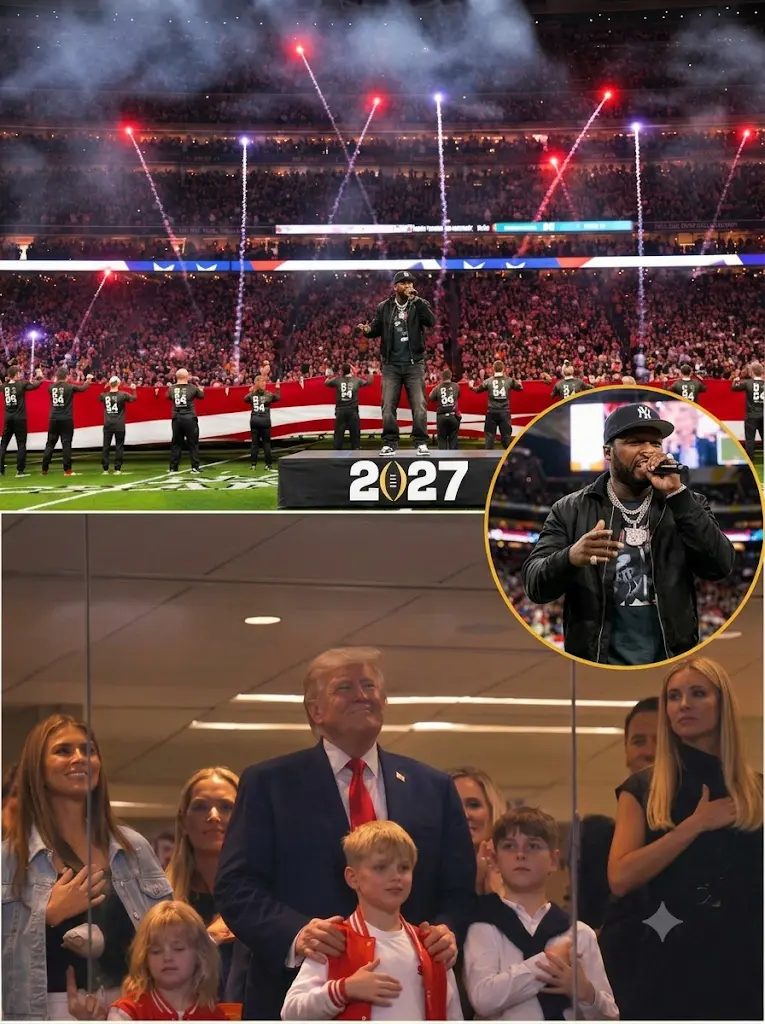
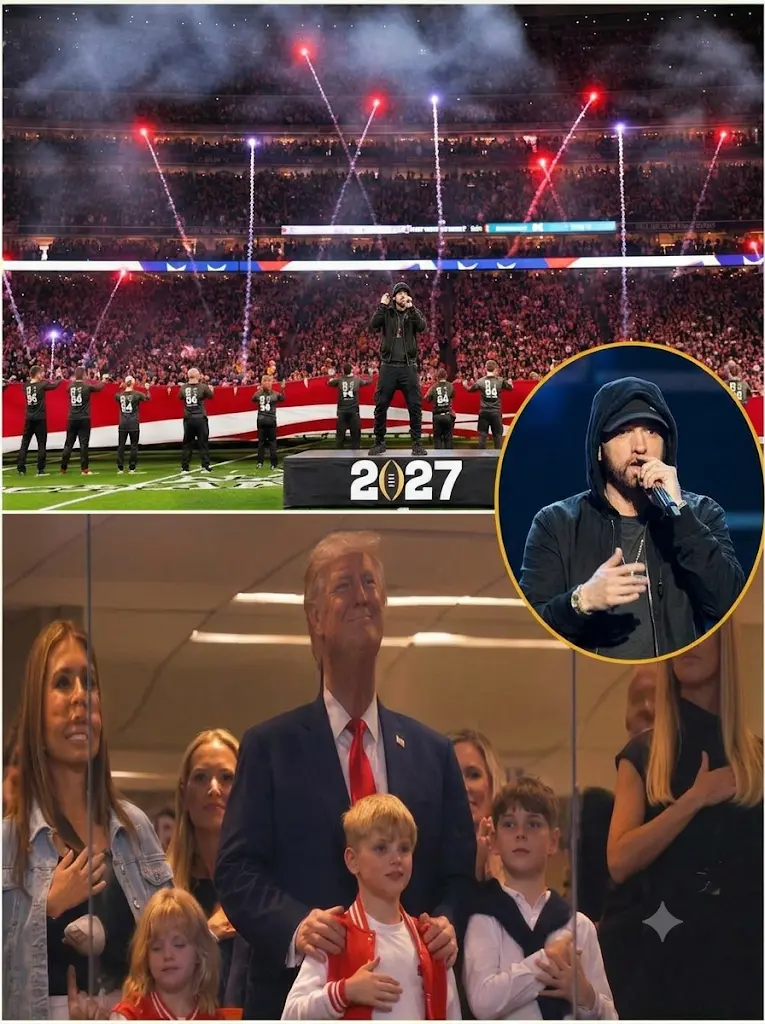
**A stadium packed with thousands of spectators. The anticipation of a major sporting event. The American flag displayed above the field. And one of the most influential artists in hip-hop history standing alone before a microphone, preparing to perform “The Star-Spangled Banner.” For Eminem, the image represents a striking departure from the explosive rap performances that made him famous — and a powerful test of musical versatility, vulnerability, and emotional expression.**
Imagine the atmosphere.
The stadium is filled with excitement. Fans are discussing the game ahead, cameras are capturing the crowd, and players are preparing for the competition.
Then the announcement comes.
Eminem is stepping into the spotlight.
The conversations begin to fade.
Thousands of spectators turn toward the field.
And suddenly, the energy of the stadium gives way to a different kind of anticipation.
There are no elaborate stage effects.
No familiar hip-hop beat.
No opportunity for a second take.
Just one performer, one microphone, and one of the most recognizable songs in American history.
The dramatic account of Eminem delivering an unforgettable national anthem performance creates a compelling scene. However, the account does not identify a verified sporting event, date, or recording. The particular performance and audience reactions described therefore cannot be treated as confirmed facts.
Nevertheless, the scenario raises a fascinating question: What would it mean for one of the greatest rappers of his generation to step outside his familiar musical identity and attempt one of the most demanding ceremonial songs in American culture?
To understand why the possibility is so intriguing, it is worth examining the extraordinary career that made Eminem a global entertainment icon.
## A VOICE THAT CHANGED THE HISTORY OF HIP-HOP
Eminem is not simply a successful rapper.
He is one of the most influential recording artists of the past several decades.
Born Marshall Bruce Mathers III on October 17, 1972, in St. Joseph, Missouri, he spent much of his youth in the Detroit area.
His early life was marked by instability, financial hardship, and difficult personal experiences.
Those struggles would later become central themes in his music.
From the beginning, Eminem developed an intense interest in language, rhythm, and storytelling.
He studied rhyme patterns and experimented with complex lyrical structures.
His dedication helped him develop a style that would eventually distinguish him from other performers.
His voice became instantly recognizable.
It could sound aggressive, sarcastic, vulnerable, humorous, or deeply emotional.
And his ability to communicate complicated feelings through rhythm helped redefine expectations for mainstream rap.
## THE MOMENT BEFORE THE FIRST NOTE
A major sporting event creates an atmosphere unlike almost any other public performance.
Thousands of spectators arrive with excitement.
Fans wear team colors.
Music plays through the stadium speakers.
Television cameras capture the anticipation.
Players prepare mentally for the challenge ahead.
Then the national anthem ceremony begins.
The atmosphere changes.
The competition temporarily becomes secondary.
The audience turns its attention toward the performer.
For a brief period, the entire venue participates in a shared ceremonial experience.
For an artist like Eminem, whose career has been built around rapid-fire lyrics and powerful rhythmic delivery, the challenge would be distinctive.
The national anthem requires sustained melodic singing rather than primarily rhythmic expression.
It demands careful breath support, pitch control, and emotional restraint.
That contrast makes the scenario especially interesting.
## NO SECOND TAKE, NO PLACE TO HIDE
“The Star-Spangled Banner” is a demanding song.
Its melody covers a wide vocal range.
The opening phrases require precision.
The final section rises toward a dramatic conclusion.
Even experienced singers can find the song challenging.
Outdoor stadiums introduce additional difficulties.
Sound may echo across the venue.
The performer may hear delayed audio.
Weather conditions can affect the experience.
And the knowledge that millions of viewers may be watching can increase the pressure.
A successful performance requires preparation and technical control.
Eminem's experience as a live performer would provide confidence and stage awareness.
But performing the anthem would require musical skills that differ from those most closely associated with his rap career.
## FROM DETROIT'S UNDERGROUND SCENE TO INTERNATIONAL FAME
Eminem developed his skills within Detroit's competitive hip-hop environment.
He participated in rap battles and worked to establish himself as a recording artist.
His early career involved considerable struggle.
He faced rejection and financial uncertainty.
But he continued writing and performing.
His technical ability gradually attracted attention.
He became known for intricate rhyme schemes, sharp delivery, and an unusual ability to combine humor with serious personal themes.
Those qualities eventually helped him reach a much larger audience.
## THE SLIM SHADY LP AND THE BREAKTHROUGH THAT CHANGED EVERYTHING
In 1999, Eminem released *The Slim Shady LP*.
The album introduced him to mainstream audiences.
Its provocative lyrics and distinctive storytelling attracted enormous attention.
The project included the hit single “My Name Is.”
Its success helped establish Eminem as one of hip-hop's most talked-about new artists.
The album also marked the beginning of his highly successful partnership with Dr. Dre.
Their collaboration became one of the defining creative relationships in modern rap.
Eminem's career accelerated rapidly.
But his success also brought intense public scrutiny.
His music generated controversy while attracting a devoted international audience.
## THE MARSHALL MATHERS LP AND A NEW LEVEL OF SUPERSTARDOM
In 2000, Eminem released *The Marshall Mathers LP*.
The album became a major commercial success.
It included songs such as “The Real Slim Shady,” “Stan,” and “The Way I Am.”
The project explored fame, public criticism, identity, and personal conflict.
Its storytelling demonstrated Eminem's extraordinary lyrical ability.
“Stan,” in particular, became one of his most influential recordings.
The song presented a dramatic narrative about obsession and the relationship between celebrities and fans.
Its cultural impact extended far beyond hip-hop.
The album helped establish Eminem as one of the most important artists of his generation.
## THE EMINEM SHOW AND THE SOUND OF A GLOBAL PHENOMENON
In 2002, Eminem released *The Eminem Show*.
The album included hits such as “Without Me,” “Cleanin' Out My Closet,” and “Sing for the Moment.”
Its themes explored fame, family relationships, political controversy, and personal identity.
The project became another enormous commercial success.
By this point, Eminem had achieved international superstardom.
His music reached audiences across different countries and cultures.
His influence extended into fashion, language, and popular entertainment.
But his artistic identity remained rooted in lyrical precision and emotional intensity.
## LOSE YOURSELF AND THE POWER OF ONE MOMENT
Few songs capture the pressure of a defining opportunity as effectively as Eminem's “Lose Yourself.”
Released in 2002 as part of the soundtrack to *8 Mile*, the song became one of the most recognizable recordings of his career.
Its lyrics explore ambition, fear, determination, and the possibility of failure.
The song reached No. 1 on the Billboard Hot 100.
It also won the Academy Award for Best Original Song.
The achievement represented a historic milestone for hip-hop.
“Lose Yourself” became an anthem of perseverance.
Its message resonated with listeners facing difficult challenges.
The song's central theme is particularly relevant to the idea of Eminem performing before a massive stadium audience.
A major live performance creates an opportunity that cannot be repeated in exactly the same way.
The performer must be prepared.
The moment arrives.
And the outcome depends on what happens next.
## THE ART OF COMMANDING AN AUDIENCE
Eminem's greatest strengths as a performer include timing, intensity, and emotional communication.
His concerts are known for energetic delivery and direct audience engagement.
He understands how to create anticipation.
He knows how to use pauses.
And he has spent decades performing before enormous crowds.
Those skills are important in live entertainment.
But a national anthem performance would require a different kind of command.
Instead of encouraging the audience to respond to a beat, the performer would need to create a respectful atmosphere.
The goal would not be to demonstrate lyrical speed.
It would be to communicate the meaning of a familiar ceremonial song.
## THE DIFFERENCE BETWEEN RAP AND TRADITIONAL SINGING
Rap and singing share important musical foundations.
Both require rhythm.
Both involve phrasing and breath control.
Both can communicate powerful emotions.
But traditional melodic singing places additional demands on pitch accuracy and sustained notes.
A rapper may possess extraordinary rhythmic ability without having the vocal range required for a demanding anthem.
Likewise, a technically accomplished singer may struggle with the precision of complex rap patterns.
The two disciplines are related but distinct.
For Eminem, performing “The Star-Spangled Banner” would therefore represent a significant musical challenge.
His stage experience would be valuable.
But careful melodic preparation would remain essential.
## THE NATIONAL ANTHEM AND ITS CULTURAL SIGNIFICANCE
“The Star-Spangled Banner” occupies an important place in American public life.
Its lyrics were written by Francis Scott Key in 1814.
The song became the official national anthem of the United States in 1931.
Today, it is performed at sporting events, national ceremonies, and public commemorations.
For many listeners, it represents patriotism, remembrance, and shared national identity.
Its performance can also carry personal significance.
Some spectators associate the song with military service.
Others connect it with family traditions or important national experiences.
A performer must recognize that the anthem may hold different meanings for different audience members.
That responsibility extends beyond vocal technique.
It requires sensitivity to the occasion.
## HIP-HOP AND THE AMERICAN CULTURAL STORY
Hip-hop is one of the most influential artistic movements to emerge from the United States.
The genre developed in New York City during the 1970s.
It later expanded into a global cultural phenomenon.
Hip-hop has shaped music, fashion, language, and popular culture.
Eminem became one of its most commercially successful figures.
His career demonstrated the genre's ability to reach audiences across cultural and geographic boundaries.
The idea of a major rapper performing the national anthem brings together two different aspects of American musical history.
One represents a longstanding national tradition.
The other reflects a modern artistic movement rooted in urban communities.
A thoughtful performance could highlight the diversity of American musical expression.
## THE SILENCE THAT CAN DEFINE A GREAT PERFORMANCE
A stadium is normally filled with noise.
Fans cheer.
Conversations fill the stands.
Music plays through the speakers.
The atmosphere is energetic.
But a powerful ceremonial performance can transform that environment.
Thousands of spectators may turn their attention toward a single voice.
Every note becomes important.
Every pause creates anticipation.
The result can feel remarkably intimate despite the enormous setting.
For Eminem, whose concerts are often associated with explosive energy, such a moment would represent a striking contrast.
The audience would not be responding to a familiar beat.
It would be listening to the performance itself.
## THE POWER OF RESTRAINT
One of the most important qualities in a successful national anthem performance is restraint.
The song does not necessarily benefit from excessive vocal embellishment.
A carefully controlled phrase may communicate more emotion than an elaborate run.
A quiet opening can create anticipation.
A natural increase in intensity can make the final note feel earned.
Eminem's music has often demonstrated the value of controlled delivery.
His most emotional recordings frequently rely on changes in intensity and pacing.
That understanding of dramatic progression could be useful in a ceremonial setting.
But it would need to be combined with the melodic control required by the song.
## MOCKINGBIRD AND THE EMOTIONAL SIDE OF EMINEM
“Mockingbird” remains one of Eminem's most emotionally significant recordings.
The song explores family relationships, personal struggles, and parental responsibility.
Its relatively restrained production allows the lyrics to remain central.
The recording demonstrates a different side of his artistic identity.
Rather than emphasizing confrontation or humor, Eminem communicates vulnerability.
That emotional range has helped sustain his connection with listeners.
A ceremonial performance would require a different kind of vulnerability.
The singer would need to communicate meaning without relying on the storytelling structure of a rap song.
## NOT AFRAID AND THE MESSAGE OF RESILIENCE
In 2010, Eminem released “Not Afraid.”
The song became one of the defining recordings of his *Recovery* era.
Its lyrics emphasized personal growth, determination, and overcoming adversity.
The recording reached No. 1 on the Billboard Hot 100.
Its success demonstrated Eminem's ability to communicate messages of resilience to a broad audience.
The song also marked an important stage in his artistic development.
For many listeners, it represented a more reflective and mature chapter in his career.
That willingness to explore personal growth has remained an important part of his musical identity.
## THE SUPER BOWL HALFTIME SHOW AND A RETURN TO THE BIGGEST STAGE
In February 2022, Eminem appeared during the Super Bowl LVI halftime show.
The performance featured Dr. Dre, Snoop Dogg, Mary J. Blige, Kendrick Lamar, and 50 Cent.
Eminem performed “Lose Yourself.”
The appearance attracted enormous attention.
It also demonstrated the enduring cultural influence of hip-hop.
The halftime show won the Primetime Emmy Award for Outstanding Variety Special (Live).
For Eminem, the performance represented another major milestone.
But participating in a large ensemble halftime production is different from singing the national anthem alone.
The latter requires a distinct musical approach.
## WHY THE FINAL NOTE MATTERS SO MUCH
The closing section of “The Star-Spangled Banner” is particularly demanding.
The melody rises toward a climactic conclusion.
The singer must maintain pitch and breath control.
The audience anticipates the final phrase.
The pressure can be enormous.
But the strongest ending is not necessarily the loudest.
It is the one that feels connected to the emotional progression of the entire performance.
A successful interpretation requires careful preparation.
The performer must understand the song's structure.
They must know when to build intensity.
And they must avoid allowing technical ambition to overwhelm the music.
For an artist whose established strengths lie in rap, mastering those demands would represent a significant achievement.
## THE POWER OF SURPRISING AN AUDIENCE
Entertainment audiences often respond strongly when a familiar artist demonstrates an unexpected ability.
A comedian delivers a moving dramatic performance.
An actor reveals an unexpected musical talent.
A singer succeeds in an unfamiliar genre.
These moments challenge assumptions.
They remind audiences that performers may possess interests and abilities beyond their best-known work.
The idea of Eminem performing the national anthem draws on that sense of surprise.
Fans know him for his extraordinary lyrical precision.
They recognize his rapid delivery.
They understand his reputation as a commanding live performer.
A traditional ceremonial song would reveal a different dimension of his musical abilities, provided he could meet its technical demands.
## WHY AUTHENTICITY MATTERS MORE THAN SPECTACLE
Some of the most memorable performances are not the most elaborate.
They are the ones that feel sincere.
A performer can deliver every note correctly without creating an emotional connection.
Another artist may use subtle phrasing to make a familiar song feel meaningful.
Authenticity often determines the difference.
Eminem's music has frequently drawn on personal experiences and direct storytelling.
That approach helped establish his credibility with listeners.
In a ceremonial setting, authenticity would require him to approach the anthem with respect while adapting to its musical demands.
The result would need to feel natural rather than forced.
## THE IMPORTANCE OF VERIFYING THE ACTUAL EVENT
The dramatic description of Eminem delivering a stadium-silencing national anthem performance is compelling.
However, it does not identify a specific sporting event, date, broadcast, or authenticated recording.
Those details are necessary before the account can be presented as a documented performance.
Without them, there is no basis for claiming that a particular stadium fell silent, that spectators reacted in a specific way, or that the event represented the largest audience of Eminem's career.
What can be discussed confidently is his established musical legacy and the challenges of performing the American national anthem.
His professional history provides a meaningful foundation for exploring why such a performance would attract attention.
But an engaging narrative should not be confused with verified reporting.
## A LEGACY THAT EXTENDS BEYOND HIP-HOP
Eminem has built a career that spans music, film, and popular culture.
His early recordings helped redefine mainstream hip-hop during the late 1990s and early 2000s.
His collaborations with Dr. Dre became part of music history.
His work on *8 Mile* introduced another dimension of his artistic abilities.
His recordings have earned numerous awards and commercial achievements.
And his influence can be heard in the work of younger rappers around the world.
That legacy is already substantial.
He does not need a national anthem performance to establish his importance.
But the willingness to explore unfamiliar artistic territory can reflect an important aspect of creative growth.
It demonstrates that success in one field does not have to prevent an artist from accepting new challenges.
## WHEN ONE VOICE BECOMES THE ENTIRE SHOW
There is something uniquely powerful about a performer standing alone before a massive audience.
The stadium may contain tens of thousands of people.
Television cameras may broadcast the moment around the world.
Yet the experience depends on one person and one performance.
Every breath matters.
Every phrase carries weight.
Every pause creates anticipation.
For Eminem, whose career has often involved elaborate productions, powerful beats, and energetic stage performances, such simplicity would be unusual.
There would be no familiar instrumental hook to carry the crowd.
No rapid-fire verses.
No elaborate visual effects.
Only the song.
And the challenge of delivering it convincingly.
## FINAL THOUGHTS: SOMETIMES THE BIGGEST STAGE REQUIRES THE GREATEST COURAGE
There are performances that entertain.
There are performances that impress.
And there are performances that reveal something unexpected about an artist.
The image of Eminem stepping before a packed stadium to sing “The Star-Spangled Banner” captures the possibility of that third kind of experience.
No elaborate production.
No hard-hitting beat.
No opportunity for a second take.
Just a performer, a familiar melody, and an audience waiting for the first note.
Eminem's career has already demonstrated extraordinary determination.
From Detroit's underground rap scene to international superstardom, he has repeatedly transformed professional challenges into major artistic achievements.
His success has influenced generations of performers.
His recordings have become part of popular music history.
And his ability to communicate powerful emotions through language remains one of his defining strengths.
A truly unforgettable national anthem performance would require another kind of accomplishment.
It would demand musical preparation, emotional control, and the confidence to step outside the familiar strengths that made him famous.
Its impact would depend on sincerity rather than spectacle.
Its significance would come from the connection between performer and audience.
And its success would ultimately be measured by the quality of the music itself.
**For Eminem, the greatest achievement in such a moment would not simply be reaching the final note. It would be demonstrating that even an established music legend can continue discovering new ways to connect with an audience.**
**Because sometimes the most extraordinary performances are not defined by fame, production budgets, or overwhelming spectacle. Sometimes, all it takes is the courage to stand alone, face the silence, and let the music speak for itself.**